
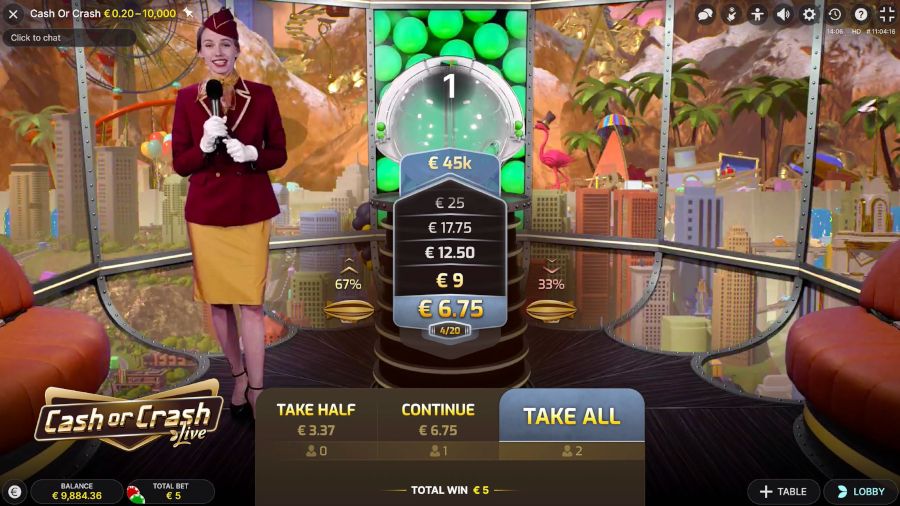
When we examine the inner workings of live TV games like Instant Access To Cash Or Crash Live, we encounter features intended to give players a semblance of influence within a high-volatility context. The Block feature stands out as amongst the most important tactical tools offered to UK players. Unlike the main game of chance, where a variable multiplier can collapse at any point, the Block permits a participant to proactively ‘lock in’ a portion of what they could win before the unavoidable crash takes place. It changes a entirely passive activity into a more engaged, choice-driven type. We regard its use as a essential risk-control strategy, distinguishing recreational play from more calculated approaches. For the UK audience, where gaming is often viewed through a prism of both fun and savvy participation, becoming proficient in this feature is crucial to managing the game’s built-in struggle between greed and security.
What the Block Function Really Does
At its core, the Block function in Cash or Crash Live is a straightforward yet potent security measure. During a round, as the multiplier goes up, a participant can hit the Block button to lock in a part of their possible payout. This step creates a secure baseline for that round’s winnings. If the game crashes at a multiplier lower than the position of their block, they still receive the protected value. If it goes beyond the block point, their potential earnings keep increasing, but the blocked sum is safe. It’s important to realize that activating the Block does not terminate your involvement in the current round; your current multiplier stays in play, but you have a safety net. We find this dual-state play—having safety while remaining active—to constitute the function’s psychological hook. For British players, it tackles the timeless issue of deciding when to cash out, an idea well-known from contexts as varied as stock trading and a nail-biting pub quiz.

Contrasting Block to Auto-Cash-Out
It’s crucial to differentiate the Block function from the individual Auto-Cash-Out feature, as UK players occasionally conflate the two. Auto-Cash-Out is a set-and-forget tool where you preselect a multiplier at which your entire bet is automatically cashed out, ending your participation in that round entirely. The Block function is more nuanced. It does not end your round; it merely secures a segment of your winnings while your live bet continues to ride. This signifies you can still profit from a climbing multiplier after blocking, which is unattainable with Auto-Cash-Out. We view Auto-Cash-Out as a tool for self-regulation, imposing a rigid profit target. The Block, though, is a tool for risk management and opportunity optimisation. A sophisticated UK player might use both in tandem—for instance, setting a moderate Auto-Cash-Out at 10x but using a manual Block at 4x to guarantee a base profit well before that target.
Building a Individual Block Strategy
Creating a unwavering personal strategy for the Block is the signature of a careful Cash or Crash Live player in the UK. We advise starting with a bankroll handling plan: decide what percentage of your session stake you are ready to risk per round and what constitutes a profitable profit target. Your Block approach should fulfill these targets. One method is the «tiered block,» where you reserve a minor percentage of your potential winnings at a modest multiplier, another part at a moderate multiplier, and let the remainder ride. Another is the «fixed profit» approach, where you compute the exact multiplier needed to obtain a specific profit and block there each round, disregarding the allure of higher multipliers. Crucially, any system must be recorded and adhered to before you commence playing, as in-play emotions will obscure judgement. The Block is a potent tool, but its potential is only realized through disciplined, pre-planned use.
Strategic Pacing for UK Participants
Well-planned application of the Block centers on timing, and UK players commonly develop patterns according to observed game tendencies and own risk appetite. There exists no globally ideal point, which is what makes it a highly debated issue. Several advocate for an first block, maybe at a conservative 1.5x or 2x multiplier, to guarantee a modest but consistent return, building a funds slowly and safely. Others, seeking bigger wins, will allow the multiplier climb much higher before activating their block. Our research shows the fact that many seasoned participants in the UK use a hybrid approach, changing their block point based on the behavior of recent games. As an illustration, after several consecutive small multiplier failures, certain players may activate their block sooner, expecting a tendency. In contrast, upon a large multiplier, the following session might see participants blocking at higher multipliers, anticipating it happening again. The crucial point is that the action is proactive and context-driven, transitioning the player from a mere spectator to an engaged participant, managing their own stake.
In what manner UK Guidelines Affect Use of Features
The use of functions like the Block does not occur in a vacuum; it’s framed by the UK’s tight gambling regulations and responsible gaming framework. The UK Gambling Commission mandates that games provide transparent information and features that foster player control. The Block function fits perfectly with this ethos, as it is a tangible tool for controlling risk and limiting losses. Additionally, the prevalence of detailed game statistics and history, which UK-licensed operators have to provide, feeds directly into Block strategy. Players can review past rounds to guide their timing, incorporating analytical strategy. We also observe that the UK sector’s emphasis on transparency results in the workings of the Block are clearly described, eliminating misinterpretation. This regulatory environment promotes a more cautious, strategic mindset to the experience, where the Block is seen not just as a button, but as a central component of informed play.
Common Blocking Mistakes to Avoid
Through our analysis of gameplay, we’ve noted several frequent pitfalls UK players should be aware of when using the Block. The most common mistake is blocking out of alarm at the first indication of a rising multiplier, often at a level so low it barely covers the initial stake. This negates the function’s purpose of securing substantial profit. Conversely, greed causes the error of never blocking at all, treating every round as an all-or-nothing gamble, which statistically wipes out gains over time. Another less obvious error is setting the block at a round, psychologically significant number like 5.0x, which many other players are also apt to use. If a crash is crafted to frequently occur just below such widespread thresholds, this strategy can backfire. We advise players to change their block points and base them on a pre-defined strategy rather than emotional impulses during the thick of the round.
Emotional Influence on Play
The implementation of the Block option profoundly modifies the mental interplay of Cash or Crash Live. In its absence, the game is a pure test of nerve, a all-or-nothing «cash out or bust» scenario that often leads to regret—caused by exiting prematurely or losing everything. The Block resolves this by furnishing a third, reassuring choice. This feature eases the anxiety of losing everything, which in turn can result in more composed and possibly more lucrative choices. We note that UK players employing the Block frequently describe feeling more empowered, which increases their enjoyment and engagement with the game. However, it also creates new forms of mental stress, such as the annoyance of blocking at 3x just to observe the multiplier increase to 10x. This «fear of missing out» (FOMO) is a potent factor, and learning to manage the emotional response to a good or bad block is equally crucial as mastering the timing.

